L&S Sonny- Genetic Color Profile
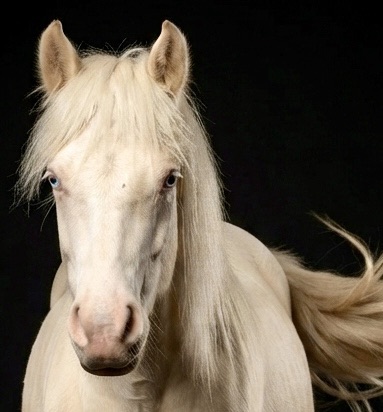
This Gypsy Vanner stallion is visually a buckskin tobiano with extensive white patterns (likely a “high white” or maximum expression pinto), and he carries hidden recessive traits. [1, 2]
His complex genetic panel breaks down into three core categories: his base color, his dilution genes, and his white spotting patterns. He is the Swiss Army knife of extremely rare genetics.
1. Base Color & Dilutions (The “Canvas”)
E/e (Black Base): He has one copy of the dominant black extension gene. He is capable of producing both black-based and chestnut-based offspring. [3]
A/a (Agouti): He has one copy of Agouti. Since he is black-based (E/e), Agouti restricts the black pigment to his points (points being his mane, tail, and lower legs), turning a black base into Bay. [3, 4, 5]
CR/n (Cream Dilution): He carries one copy of the dominant Cream gene. This single copy dilutes his bay base coat into a beautiful Buckskin (golden body with black points). [5, 6, 7, 8]
nd2/nd2 (Non-Dun): He does not carry any Dun dilution or primitive dun markings (like dorsal stripes). His body color will remain crisp and clear. [9, 10]
prl/n (Pearl Carrier): He carries one hidden copy of the recessive Pearl dilution. Because it is recessive, it does not change his appearance, but he can pass it to his foals. [11]
2. White Spotting Genes (The “Paint”)
This stallion has an incredible array of white-pattern genes that interact additively, meaning he will likely be a very loudly marked horse with significant white coverage. [2]
TO/n (Tobiano): The primary pinto gene in Gypsy Cobs. It typically causes clean-edged, vertical white patches that cross over the spine. [5, 12, 13, 14]
SB1/n (Sabino 1): Adds jagged white markings, usually extending up the legs, onto the belly, and creating a wide facial blaze, often accompanied by “roaning” or flecking at the edges. [5, 15, 16]
W32/n (Dominant White 32): A modern KIT gene variant discovered by Etalon Diagnostics. It causes a bold white facial blaze, white stockings, and belly spots. [17]
EDXW3/n (Eden White 3): A newly discovered mutation found frequently in Gypsy Vanners and Shires. It acts on the HPS5 gene to cause unusual white spotting, belly splashes, or “mask” patterns. Interestingly, Etalon’s research on Eden White shows that it interacts strongly with a black base (E/-), causing even more dramatic depigmentation (more white) than it would on a chestnut horse. [18, 19, 20, 21]
Summary of Breeding Potential
As a breeding stallion, he is an asset for producing color. He will pass on: [22]
The Cream gene to 50% of his foals.
The hidden Pearl gene to 50% of his foals. If bred to a mare with Cream (CR/n) or Pearl (prl/n), he could sire a “Cream-Pearl” pseudo-double dilute.
At least one white pattern gene (TO, SB1, W32, or EDXW3) to almost every foal, making it highly likely that his offspring will be colorful pintos or loudly marked. [6]
To recap:
As recorded with the GVHS studbook 2026
A/a
,
E/e
,
CR/n
,
nd2/nd2
,
W32/n
,
SB1/n
,
TO/n
,
EDXW3/n
,
prl/n
[2] https://www.quarterhorsenews.com
[3] https://gypsysoulhorses.com
[6] https://www.gypsyhorseassociation.org
[7] https://www.coastalequineservices.com
[9] https://www.horseeducationonline.com
[10] https://horsereality.wiki
[14] https://horsereality.wiki
[15] https://generatio.de
[16] https://pmc.ncbi.nlm.nih.gov
[19] https://www.mdpi.com
 NK Equine Services